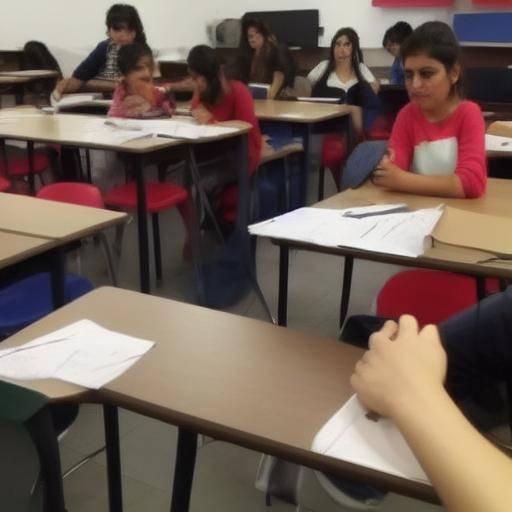
Artificial intelligence (IA) has transformed many aspects of our lives, including education. At present, learning evaluation has evolved through artificial intelligence applications, providing new opportunities to analyse, understand and improve the teaching and learning process. In this article, we will explore how artificial intelligence is used to evaluate learning, its benefits, challenges, and the impact it is having on education. In addition, we will provide practical advice, expert opinions, case studies, and reflections on future trends.
Introduction
The evaluation of the educational process is crucial to measuring the progress of students and determining the effectiveness of teaching methods. Artificial intelligence offers the ability to quickly and accurately analyze large amounts of data, which has innovative applications in learning assessment. As educators and educational systems seek more effective ways of understanding and supporting the learning process, artificial intelligence emerges as a powerful and promising tool.
History and Background
Artificial intelligence has its roots in seeking to replicate human intelligence through technology. Since its inception in the 1950s, it has experienced significant advances that have paved the way for its integration into various fields, including education. The development of automatic learning algorithms, the increase in the processing power of computers and access to large volumes of data have been fundamental for the advancement of artificial intelligence in the educational evaluation.
The integration of AI into the educational evaluation has been a progressive process, with significant milestones that include the creation of intelligent mentoring systems, data-based learning customization, and the detection of performance patterns to identify areas of improvement.
Analysis in Deep
The use of artificial intelligence in learning assessment provides many benefits. The ability to analyze data on a massive scale allows educators to quickly identify areas of strength and weakness in student learning, which in turn facilitates the personalization of the educational process. In addition, AI can help mitigate biases and prejudices in evaluation by focusing on objective metrics and previously established performance standards.
However, the implementation of artificial intelligence in the educational evaluation also poses challenges. Data privacy, equity in access to advanced technologies, and resistance to change are important considerations that need to be addressed to ensure that the application of AI in learning assessment is ethical and effective.
Comprehensive review
Artificial intelligence is being applied in various ways in learning assessment. From automated evaluation systems that analyze open responses to the generation of personalized feedback for students, the AI is transforming the way learning is evaluated. Educators and decision makers in the educational field are actively exploring how to effectively integrate AI into evaluation processes to improve educational outcomes.
The comparison of different educational evaluation approaches, from traditional methods to AI-driven solutions, offers a holistic view of the strengths and limitations of each approach. By understanding the practical and theoretical implications of artificial intelligence in learning assessment, you can make informed decisions about its implementation and optimization.
Comparative analysis
Artificial intelligence, evaluation and learning are intrinsically intertwined in the evolution of education. While AI provides advanced capabilities to analyze data and generate unique perceptions of learning, it is essential to note that it does not replace the importance of human interaction in the educational process. The combination of artificial intelligence with pedagogytraditional can boost a holistic approach that takes advantage of the best of both dimensions, enhancing learning assessment.
Practical Tips and Accessible Tips
In considering the implementation of artificial intelligence in learning assessment, it is crucial to take into account several key factors. These include the selection of tools and platforms focused on equity and diversity, the training of educators to maximize AI capabilities, and transparency in the evaluation process to build confidence and student participation.
Here are some useful tips for maximizing artificial intelligence in learning assessment:
- Training: Provide continuous training to educators on the ethical and effective use of artificial intelligence in learning assessment.
- Equity: Ensure that AI-driven evaluation tools are equitable and bias-free, promoting inclusion and diversity.
- Student participation: Involve students in the process of using AI for evaluation, promoting transparency and understanding of how technologies are applied.
- Personalized feedback: Using AI to provide individualized and growth-oriented feedback, which can improve the motivation and commitment of students.
Industry Perspectives and Expert Reviews
Leaders in the field of education, technology and artificial intelligence have valuable insights on the evolving role of AI in learning assessment. Their views and reflections provide a profound insight into the impact and future possibilities of integrating artificial intelligence into education.
According to Dr. María Sánchez, expert in educational technology: "The artificial intelligence has the potential to revolutionize the way we evaluate the learning, providing detailed and procedural information that can inform effective pedagogical strategies". This approach highlights the importance of considering not only the current use of AI in evaluation, but also the long-term impact on the continuous improvement of teaching and learning.
Case Studies and Real Life Applications
Case studies provide tangible examples of how artificial intelligence is influencing learning assessment in real educational environments. From the identification of learning patterns to the adaptation of educational resources based on individual needs, these cases illustrate the transformative potential of AI in the educational evaluation.
In a primary school in the city of Barcelona, Spain, an artificial intelligence-based evaluation system was implemented that analyzed the progress of students in mathematics. The results showed that the personalized feedback generated by the IA contributed to a significant improvement in academic performance, as well as greater self-confidence and motivation among students.
Future Trends and Predictions
The rapid evolution of artificial intelligence and its impact on learning assessment point to important future trends. The advance in the development of automatic learning algorithms, the integration of AI into existing educational platforms, and the growing collaboration between educators and AI experts stand out a future in which learning assessment will increasingly benefit from the capabilities of artificial intelligence.
Artificial intelligence is expected to expand its scope in learning assessment, addressing areas such as early detection of learning difficulties, even deeper personalization of the educational process, and the creation of more inclusive and equitable evaluation environments.
Conclusion
Artificial intelligence offers significant potential to transform learning assessment, allowing deeper analysis, personalized feedback and a more holistic approach to teaching and learning. As technology continues to move forward, it is crucial to maintain an ethical and equitable approach to the implementation of artificial intelligence in educational evaluation, ensuring that it remains a support tool for educators and students.
Frequently asked questions
How is artificial intelligence used in learning assessment?
The AI is used in learning evaluation by analyzing data generated by students, identifying performance patterns, customizing feedback and generating insights to inform educational decision-making.
What are the benefits of artificial intelligence in educational evaluation?
The benefits include the ability to quickly analyze large volumes of data, the generation of custom feedback, the identification of improvement areas and the mitigation of bias in the evaluation.
What are the challenges of the implementation of artificial intelligence in learning assessment?
Some challenges include data privacy, equity in access to advanced technologies, and resistance to change in traditional evaluation methods.
How can artificial intelligence improve equity in educational evaluation?
AI can help improve equity by focusing on objective metrics, mitigate biases in evaluation, and customize feedback more in an inclusive way.
What are some practical applications of artificial intelligence in learning assessment?
Practical applications include automated evaluation systems, personalized feedback generation, early detection of learning difficulties, and adaptation of educational resources.
What is the role of human interaction in the evaluation of artificial intelligence-driven learning?
Human interaction remains fundamental to the educational process, and the combination of artificial intelligence with traditional pedagogy can boost a holistic approach that takes advantage of the best of both dimensions.
With this, we concluded our exploration of artificial intelligence in learning assessment. We hope that this article has provided a clear and profound understanding of the subject, as well as practical ideas for its implementation and reflection on its future impact on education.