In the digital era, scientific education has undergone significant transformation thanks to the advance of technology. Within this context, virtual laboratories play a key role in providing students with a practical, interactive and enriching experience in the scientific field. This article will provide a detailed overview of the importance of virtual laboratories in scientific education, exploring their history, current impact, practical applications, future prospects and much more.
Introduction
Technology has revolutionized teaching and learning, and in the field of scientific education, virtual laboratories have emerged as an invaluable tool. These digital environments realistically simulate scientific experiments, offering students the opportunity to explore complex concepts, develop practical skills and consolidate their theoretical understanding. As we immerse ourselves in the topic of virtual laboratories in scientific education, we will examine their evolution, current impact and role in the formation of future scientists and professionals.
History and Background
The concept of virtual lab has its roots in the 1990s when computer technology began to integrate significantly in the educational field. As the Internet connection was generalized, specialized platforms and software emerged that allowed the simulation of scientific experiments in virtual environments. This revolutionary innovation opened new possibilities in the teaching of science, eliminating geographical and financial barriers by providing access to practical experiences from any location with Internet connection.
Over the past decades, virtual laboratories continued to evolve, adopting advanced technologies such as virtual reality (VR) and increased reality (AR) to provide even more immersive experiences. This continuous technological development has significantly expanded the capabilities and effectiveness of virtual laboratories, consolidating its position as an essential tool in scientific education at all levels, from secondary schools to high-level academic institutions.
Analysis in Deep
Virtual laboratories enrich scientific education in various ways, but also pose important challenges and considerations. The flexibility and accessibility they offer are key aspects that promote more inclusive and personalized learning. On the other hand, the need to maintain the integrity of virtual experiments and ensure the acquisition of practical skills is a challenge that educators and developers continue to address.
At present, virtual laboratories have proven to be particularly valuable in situations where physical experiments have limitations, whether for cost issues, safety or availability of specialized equipment. In addition, the ability to repeat and modify experiments in a virtual environment provides students with the opportunity to experiment with different variables and scenarios, enriching their understanding of scientific concepts and fostering curiosity and creativity.
Detail
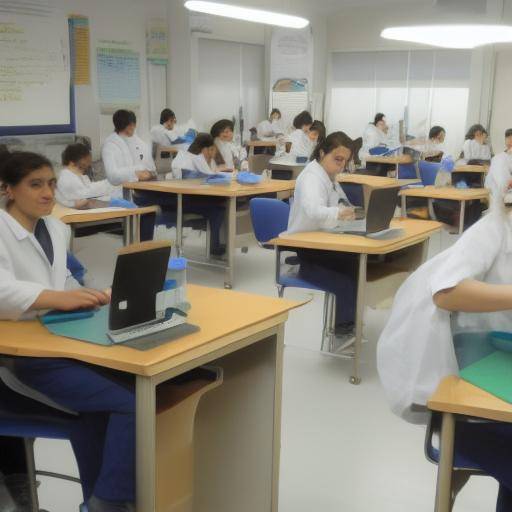
The applicability of virtual laboratories covers a wide range of scientific disciplines, from biology and chemistry to physics and engineering. Practical examples include the simulation of chemical reactions, the study of human anatomy in 3D environments, the exploration of complex physical phenomena and the practice of laboratory skills in a safe virtual environment. These applications offer significant benefits for both students and educators, providing a versatile and effective platform for teaching and learning scientific concepts.
The future of virtual laboratories in scientific education seems promising, with continuous advances in technologies related to virtual reality, artificial intelligence and data visualization. These advances have the potential to further improve immersion and interactivity in virtual environments, bringing the laboratory experience to real life in ways never seen. In addition, the development of integrated data analysis tools in virtual laboratories allows students not only to perform experiments, but also to interpret and contextualize results, strengthening their analytical and critical skills.
Comparative analysis
By comparing virtual laboratories with physical laboratories, there is an interesting debate about the advantages and disadvantages of each approach. While physical laboratories offer a direct sensory and tactile experience, virtual laboratories provide flexibility, global availability and the ability to simulate difficult situations to reproduce in a physical environment. The combination of both approaches, known as "hybrid learning", offers a balance between practical experience and the advantages of technology.
Specific examples of this approach can be found in STEM education (science, technology, engineering and mathematics), where the integration of virtual laboratories into study programs complements classroom instruction and provides students with a holistic view of scientific concepts. This combination offers a greater variety of learning opportunities and prepares students to face multidisciplinary challenges in the real world.
Practical Tips and Accessible Recommendations
For educators and students interested in maximizing virtual laboratories, it is essential to establish a structured and focused approach to learning objectives. Some recommendations include the integration of virtual laboratories into study plans in a coherent manner, the promotion of experimentation, exploration and collaboration among students, and the continued assessment of the effectiveness of virtual laboratories in achieving educational objectives.
In addition, access to quality resources and training in the effective use of virtual laboratories are critical aspects to ensure their successful implementation. Educators seeking to integrate virtual laboratories into their educational programs can benefit from collaboration with educational technology professionals and the design of custom virtual laboratories that align with the specific objectives of the curriculum.
Industry Perspectives and Expert Reviews
The perspectives of experts in the field of scientific education highlight the importance of virtual laboratories as a tool that expands the scope and effectiveness of scientific teaching. Continuous technological advances have allowed the development of increasingly sophisticated virtual laboratories, capable of simulating complex scenarios and fostering active exploration by students.
In the future, expert opinions suggest that integrating data analysis and collaborative tools into virtual laboratories will remain a key area of focus. In addition, the expansion of virtual laboratories into interdisciplinary disciplines and the integration of gamification elements and augmented reality promise to further enrich the educational experience for students.
Case studies and practical applications
Case studies highlighting the successful application of virtual laboratories in educational and professional environments provide a valuable insight into the specific benefits they provide. From academic institutions that have significantly improved student participation and performance through the implementation of virtual laboratories, to companies that use virtual simulations to train their staff in safe and controlled environments, practical examples reinforce the relevance and effectiveness of this tool.
The practical approach, adaptability to different contexts and customization capacity are common elements that emerge from these case studies, emphasizing the versatility of virtual laboratories to meet various educational and professional needs.
Future Trends and Predictions
As technology continues to evolve, virtual laboratories are likely to continue to expand into new areas and disciplines, opening new opportunities for experimentation and collaboration. The integration of artificial intelligence to customize the learning experience, the use of virtual environments for collaborative scientific research worldwide, and the creation of communities of practice in virtual environments are just some of the possible future directions that promise to further transform scientific education.
Conclusion
In short, virtual laboratories play a key role in scientific education, offering students of all ages and levels a practical and enriching way to explore scientific concepts. Its continuous evolution, practical applications and potential to enrich teaching and learning make virtual laboratories an essential tool in the modern educational landscape. As we move towards a technology-driven future, virtual laboratories will continue to play a crucial role in preparing future generations to address scientific and technological challenges.
Frequently asked questions
What is the difference between a virtual lab and a physical lab?
Virtual laboratories are digital environments that simulate scientific experiments, allowing students to practice and explore concepts without the need for physical equipment. On the other hand, physical laboratories involve conducting experiments with real equipment and materials in a physical environment.
What are the key challenges in the implementation of virtual laboratories in scientific education?
Some challenges include ensuring the integrity of practical experience, technological accessibility for all students, and adequate training for educators in the effective use of virtual laboratories.
In what scientific disciplines are virtual laboratories most frequently applied?
Virtual laboratories are widely used in disciplines such as biology, chemistry, physics, engineering and medicine. However, its applicability extends to a variety of scientific and technological fields.
How can educators effectively integrate virtual laboratories into their study plans?
Effective integration involves the alignment of virtual laboratories with learning objectives, the facilitation of active experimentation, and the continuous assessment of their impact on the achievement of educational objectives.
What are future trends in the development of virtual laboratories?
Future trends include artificial intelligence integration, global collaboration in virtual environments, and expansion into new interdisciplinary and research areas.
What is the importance of virtual laboratories in contemporary scientific education?
Virtual laboratories play a crucial role in offering a practical and enriching experience, overcoming the limitations of physical laboratories and preparing students to be critical and competent thinkers in the scientific and technological field.
In conclusion, virtual laboratories have transformed scientific education by providing a versatile and accessible platform for the exploration and practical learning of scientific concepts. Its continuous evolution and potential to enrich teaching and learning make virtual laboratories an essential tool in the modern educational landscape. With the promise of continuous technological advances, virtual laboratories will continue to play a crucial role in preparing future generations to address the scientific and technological challenges with confidence and competence.